Posts

January 8, 1945: As the temperatures stay extremely low, weapons have to be maintained and truck engines run every half-hour to prevent their oil from congealing.

Image
January 8, 1945: As the temperatures stay extremely low, weapons have to be maintained and truck engines run every half-hour to prevent their oil from congealing.  The offensive moves forward regardless, and the Allies continue to push the Germans back, reducing the dangerous salient into the Allied front line. Allied forces eliminate German positions on the west bank of the Maas River.  In the Ardennes, American forces now control 9 miles of the Laroche-St. Vith road. US 3rd Army captures Flamierge, 9 km north-west of Bastogne, on the southern flank of the German held salient. Meanwhile, in Alsace, the battles north and south of Strasbourg continue. The US 7th Army is under considerable pressure near Rimling, Aschbach, Gambsheim, Dresenheim, Rohrweiler, and Herrlisheim. January 8th saw three different men, fighting in different locations along the front, awarded America’s highest award for valor. These citations give us some idea of the intensity of the individual battles bei...

October 7, 1944: Canadian forces (elements of British 21st Army Group) establish two bridgeheads over the Leopold canal but German forces successfully stop the advance and counterattack.

Image
October 7, 1944: Canadian forces (elements of British 21st Army Group) establish two bridgeheads over the Leopold canal but German forces successfully stop the advance and counterattack.  The US 1st Army penetrates the German held Siegfried Line to the north of Aachen, attacking Alsdorf, Baesweiler, Kerkrade, and Schmidt. Meanwhile, to the south, forces of US 3rd Army (part of US 12th Army Group) gain some ground in Luxembourg and near Metz, attacking around Echternach, Wormeldange, and Fort Driant. Ferocious German counterattacks prevent significant progress. US 7th Army captures Vagney. Over the western front, US 8th Air Force attacks Politz with 142 bombers, Ruhland with 59 bombers, Merseburg with 129 bombers, Lutzkendorf with 88 bombers, Bohlen with 86 bombers, Kassel with 310 bombers, Magdeburg with 87 bombers, and targets of opportunity with 510 bombers. US 15th Air Force attacks Vienna with 350 bombers. RAF Bomber Command sends 351 aircraft to attack Kleve, 340 aircraft to a...

1945 - Audie Murphy, the most decorated U.S. service member of World War II earned his legacy in a fiery fashion.

Image
This Day in American Military History - January 26th 1945 - Audie Murphy, the most decorated U.S. service member of World War II earned his legacy in a fiery fashion. Murphy received the Medal of Honor for valor that he demonstrated at the age of 19 for single-handedly holding off a company of German soldiers for an hour at the Colmar Pocket in France in January 1945, then leading a successful counterattack while wounded and out of ammunition. Audie Leon Murphy (20 June 1925 – 28 May 1971) was an American soldier, actor, songwriter, and rancher. Murphy was born into a large family of sharecroppers in Hunt County, Texas. His father abandoned them, and his mother died when he was a teenager. Murphy left school in fifth grade to pick cotton and find other work to help support his family; his skill with a hunting rifle helped feed his family. After the attack on Pearl Harbor in 1941, Murphy's older sister helped him to falsify documentation about his birthdate in order to meet the mini...

This Day in History Jan 4, 1944 Operation Carpetbagger: U.S. aircraft begin dropping supplies to guerrilla forces throughout Western Europe.

Image
This Day in History Jan 4, 1944 Operation Carpetbagger: U.S. aircraft begin dropping supplies to guerrilla forces throughout Western Europe. The action demonstrated that the U.S. believed guerrillas were a vital support to the formal armies of the Allies in their battle against the Axis powers. Virtually every country that experienced Axis invasion raised a guerrilla force; they were especially effective and numerous in Italy, France, China, Greece, the Philippines, Yugoslavia, and the Soviet Union.  Also referred to as a “partisan force,” a guerrilla army is defined roughly as a member of a small-scale “irregular” fighting force that relies on the limited and quick engagements of a conventional fighting force. Their main weapon is sabotage-in addition to killing enemy soldiers, the goal is to incapacitate or destroy communication lines, transportation centers, and supply lines. In Italy, the partisan resistance to fascism began with assaults against Mussolini and his “black shirts...

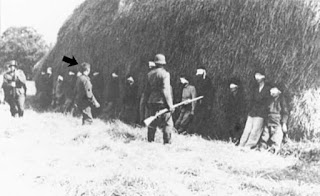
A young German soldier (pictured center left, without helmet) refuses to participate in the execution of 16 Yugoslav civilians.

Image
A young German soldier (pictured center left, without helmet) refuses to participate in the execution of 16 Yugoslav civilians.  He positioned himself within the group and was executed for disobeying his NCO. He choose death instead of killing hopeless civilians. His name was Josef Schulz. Josef Schulz, also spelled Joseph Schultz (Serbian: Jozef Šulc), was a German soldier of the 714th Infantry Division stationed in the Balkans, Serbia during World War II. He died in 1941, allegedly executed after refusing to take part in a partisan execution. The German High Command recorded him as killed in action. The plot of the Yugoslav short movie Joseph Schultz (1973) is based on the incident. Based on a Bundesarchiv study, the incident was dismissed as a legend by scholars in the 1990s. Josef Schulz was born in 1909[citation needed] and lived in Barmen, Wuppertal, Germany. During World War II, he served as a corporal in the 714th Infantry Division of the Wehrmacht. He is officially recorde...

MOH USA WW II

Image
MOH USA WW II  9/17/1944, Sgt Harold O. Messerschmidt fought enemy alone hand to hand until KIA, near Radden, France. 9/17/1944, 1st Lt Donald K. Schwab dismantled strong German position & took 1 POW. Harold O. Messerschmidt (October 20, 1923 – September 17, 1944) was a United States Army soldier and a recipient of the United States military's highest decoration—the Medal of Honor—for his actions in World War II. Messerschmidt joined the Army from Chester, Pennsylvania in May 1943,[1] and by September 17, 1944 was serving as a Sergeant in Company L, 30th Infantry Regiment, 3rd Infantry Division.  During a German attack on that day, near fr:Raddon-et-Chapendu, France, he led and encouraged his men until everyone in his unit had been killed or wounded. Ignoring his own wounds, he continued to fight the enemy force alone in hand to hand combat until he was killed. He was posthumously awarded the Medal of Honor ten months later, on July 17, 1946. Messerschmidt, aged 20 at his ...

THE BAZOOKA

Image
THE BAZOOKA Immediately recognizable and with a name that everyone remembers after the first mention, the bazooka is one of the most iconic weapons of all time. Developed in the early 20th century, this recoilless anti-tank rocket launcher, nicknamed also "stovepipe", was first introduced widely during World War II.  Although it had its flaws, General Dwight D. Eisenhower, Supreme Allied Commander of the Allied Expeditionary Force mentioned the bazooka among the four "tools of victory" in WWII along with the atomic bomb, the C-47 Skytrain transport plane, and the Jeep. Today, bazooka has become a generic term for shoulder-fired rocket launchers in the public.  The development of the bazooka entailed two separate technologies: rocketry and shaped-charge warheads. Like many weapons of World War II, it was a high-powered weapon that was scaled down for increased mobility and ease of fire.  The concept behind the bazooka was to create a handheld weapon that could inflic...