Posts

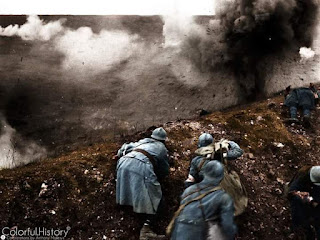
Battle of Verdun, impressions of the fight in the Reduce of Thiaumont
Image
Battle of Verdun, impressions of the fight in the Reduce of Thiaumont Testimonial passages of German soldier Wilhelm Hermanns of the 67th Infantry Regiment, who was destined in the abusive structure of the Thiaumont Reduce, at the end of October 1916, within the scope of the colossal battle of Verdun: "The entrance was a simple hole in the desolate field of the countryside" battle, and the silhouettes of men shrunk with fear, constantly going out and in cramped, looked like giant ants in the middle of darkness. I went down an iron staircase to that concrete cave about twelve feet deep. It was a huge place, filled with hundreds of soldiers. Some were in their bunk beds, sleeping, snoring or whining.  Others crowded the hallways between the bunk beds, chatting or writing letters. And some were sitting or kneeling in a corner, picking up their stuff or pulling it out of the ditches. The reflection of a lantern or that of a candle, a match or a lit cigarette flashed the darkness ...

A Tunnel Dug by a Giant Ground Sloth in Brazil Over 10,000 Years Ago

Image
A Tunnel Dug by a Giant Ground Sloth in Brazil Over 10,000 Years Ago Known as Paleoburrows, these enormous tunnels can measure up to 2,000 feet long and over six feet tall. It is believed that the Brazilian tunnels were created by giant ground sloths. How were they discovered? In the early 2000s, Professor Heinrich Frank of the University of Rio Grande do Sul was driving by a construction site when something caught his eye. There was a strange hole that had been revealed by the site's excavators, and Frank wondered where it led. A few weeks later, he made his way back and entered the hole. Crawling down the 15-foot-long opening, he noticed claw marks across the ceiling of the cave. Given his expertise, he knew that no natural phenomenon would create a cave with those characteristics, and that it must have been done by a large animal. The animal would have been what is known as a Megatherium, an extinct genus of ground sloths endemic to South America. Twitter Cre...

A watch discovered amidst the debris of Hiroshima

Image
A watch discovered amidst the debris of Hiroshima bore witness to the fateful moment of the atomic bomb's detonation on August 6th, 1945, precisely at 8:15 AM.  This tragic event occurred near the end of World War II when an American B-29 bomber unleashed a nuclear bomb upon the Japanese city, resulting in the immediate loss of approximately 80,000 lives.  Several days later, Nagasaki faced a similar fate as another nuclear bomb claimed the lives of 40,000 people.  The aftermath of these bombings led to the gradual demise of thousands more individuals due to the devastating effects of radiation.  Among the artifacts recovered from the ruins of Hiroshima were numerous timepieces, frozen forever at 8:15 AM, the precise moment when the city was forever altered by the destructive power of the nuclear bomb.

A Baby Was Just Born From An Embryo That Was Frozen 27 Years Ago

Image
A Baby Was Just Born From An Embryo That Was Frozen 27 Years Ago Molly Gibson's birth is believed to have set a world record for the oldest-known frozen embryo to result in a successful delivery. An embryo that was frozen in 1992 was implanted into the uterus of a woman earlier this year — and now, that embryo has just successfully been born as a healthy baby girl named Molly Gibson. The embryo from which Gibson was born also may be the oldest-known embryo in the world to result in a successful birth. According to CNN, Gibson’s birth was made possible through the services of the National Embryo Donation Center, a faith-based nonprofit in Knoxville, Tennessee, that stores frozen embryos donated to patients hoping to become pregnant through vitro fertilization (IVF). Parents who are unable to have children the traditional way, like Molly’s parents Tina and Ben Gibson, are able to “adopt” these unused embryos and have them surgically implanted into the adoptive parent’s uterus. In thi...

The Thinking Man's ‘All Quiet on the Western Front’

Image
The Thinking Man's ‘All Quiet on the Western Front’ In 1930 Georg Pabst’s ‘Westfront 1918’ was Germany’s most anticipated cinema release.  It chronicled the shattering impact of the Great War upon four German soldiers on the Western Front.   The film lived up to expectations. At its premiere in Berlin, its unsparing realism reportedly caused 20 people to faint.  In the film’s most harrowing scene, a disillusioned lieutenant suffers a nervous breakdown and slides into insanity. He repeatedly shouts ‘Hurrah’ as he salutes a pile of corpses. The film was a critical success. A correspondent dubbed it ‘the most vivid argument yet contrived against war.’ The film has also stood the test of time.  In 1995 it was selected as one of the 100 most significant German movies ever made.  ‘Rotten Tomatoes’ scored it 100%, with one critic labelling it as ‘the thinking man's “All Quiet on the Western Front”.’ Yet the obvious question is, why have so few people ever heard of...

Miller regretted leaving the front, and wrote in a letter to her Vogue editor “it is very bitter to me to go to Paris now that I have a taste for gun powder”.

Image
Evacuating wounded in Normandy (Lee Miller archives, England 2014. All rights reserved) Aerial bombardment of St Malo (Lee Miller archives, England 2014. All rights reserved) Fred Astaire signing autographs (Lee Miller archives, England 2014. All rights reserved) Miller regretted leaving the front, and wrote in a letter to her Vogue editor “it is very bitter to me to go to Paris now that I have a taste for gun powder”.  Scherman described the scene that met them in the liberated city: “It was an orgy of tanks, flags, newsmen, German snipers, cheering crowds and crazy, over-elaborate Paris fashions. We expected ill-clad grey mice and found cork-shod, balloon-skirted, high-coiffed beauties… Lee immediately looked up old friends, including a delighted Picasso.” A world away from the battlefront, in Paris Miller photographed Marlene Dietrich in a satin coat by Schiaparelli and Fred Astaire signing autographs for the “bare-bottomed girls of the cast in feathers”. Yet she never settled b...

This is the Legend of Anna Maria Stockhausen.👻

Image
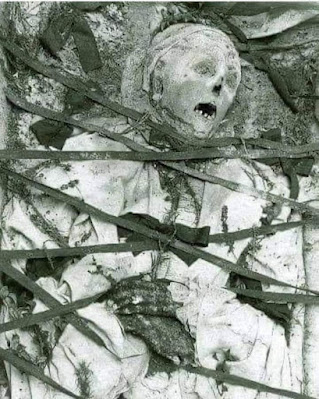
This is the Legend of Anna Maria Stockhausen.👻 "This is Anna Maria Von Stockhausen’s corpse, strapped to keep her coming back from the dead. She was accused of being a witch during the Middle ages and Black Plague. This folklore about Anna was that she was killed about 6 times. She was first hanged and later clawed herself out of the grave. The town people captured her in a nearby town and quickly drowned her in a lake, by tying her to a plank. The townspeople said they checked her several times after dragging her lifeless body out of the water.  They buried her again, only to see an empty grave 2 days later! It was said they found her rotting corpse dwelling in her old place, with worms, dirt and water spitting out of her. So the townspeople dragged her out, drove a stake in her heart and once again buried.  They placed a guard at her grave and felt she was finally buried for good. The guard failed to check in for 4 days, so a local priest went to find him, it was said that ...

This weekend marks another milestone for me – it’s exactly 50 years since I set a record I believe remains unbroken.

Image
This weekend marks another milestone for me – it’s exactly 50 years since I set a record I believe remains unbroken.  The 16-year-old me had landed in New Zealand the day before, an immigrant from the UK. At 5pm on Sunday, October 4, I was delivered by relatives to Wellington College where I was to become a boarder for the final school term of 1970.  A few minutes after 9pm, I was marched from my dormitory to an empty corridor by a teacher who insisted I bend over. He then belted me six times with a heavy leather strap across my pyjama-clad rear. My crime? I’d been talking (no surprise there). I’d owned up to it when the teacher stuck his head through the door, asking who was breaking the rule of silence after lights out.  My beating earned me instant notoriety among my new peer group for getting “six of the best” before I had seen the inside of a classroom – an all-time school record for corporal punishment in the shortest possible time. The welts (sitting was awkward fo...

In the 1720s, a Scottish woman named Margaret Dickson was found trying to abandon the body of her newborn baby near the banks of the River Tweed.

Image
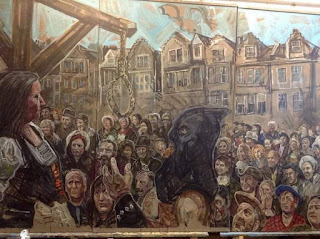
In the 1720s, a Scottish woman named Margaret Dickson was found trying to abandon the body of her newborn baby near the banks of the River Tweed. It isn’t known whether she lost the child in the late stages, or whether it died shortly after being born. Nonetheless, she was arrested charged and taken to Edinburgh to face trial, where she was found guilty and sentenced to death. In 1724, Dickson was hanged but somehow survived. She was then  allowed to go free because under Scots Law, her punishment had been carried out, she could not be executed for a second time for the same crime. This prompted the wording of the law to be changed to hanged “until dead".

In August 1961, a daring East German soldier defied orders to aid a young boy's escape across the newly built Berlin Wall.

Image
In August 1961, a daring East German soldier defied orders to aid a young boy's escape across the newly built Berlin Wall.  The picture capturing this act likely dates back to when the wall was first erected. The boy was caught on the wrong side, separated from his parents who were in West Berlin visiting relatives. Despite the stern commands of the East German government prohibiting passage, the soldier chose to help the boy cross the barbed wire to rejoin his family.  As this moment was captured, his superior reportedly noticed him, leading to his removal from the unit. His fate remains unknown. Speculation ranges from him possibly being reassigned away from the wall if fortunate, to serving a prison sentence for insubordination if not.  It is unlikely he was executed, as capital punishment was generally reserved for those guilty of high treason.

Pictures taken during the Battle for Hill 192 in Normandy - June/July 1944

Image
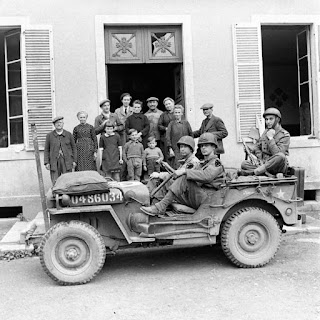
Pictures taken during the Battle for Hill 192 in Normandy - June/July 1944 Note that some of these pictures were taken in or near Saint-Georges-d'Elle Hill 192 was located between the cities of Saint-Lô and Bayeux in Normandy. The Battle was fought between elements of the 2nd US Infantry Division and the 16,000 strong 3rd German Fallschirmjäger (Parachute) Division, commanded by Generalleutnant Richard Schimf. Hill 192 gave the defending German forces good observation for miles in every direction. It needed to be taken in order for US General Omar Bradley to drive behind the German left flank and break out of Normandy; the attack that would become Operation Cobra. The terrain around Hill 192 also provided the German defenders excellent cover & concealment. US Lt. General Joseph Lawton Collins, found it worse country to fight in than Guadalcanal. The long battle among the Hedgerows finally culminated on July 10 when US forces captured Hill 192 and the surrounding area LIFE Magaz...

German soldiers launching an attack on 'Dead Man's Hill' during the Battle of Verdun, March 15-16, 1916. (Likely staged)

Image
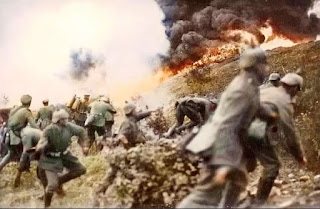
German soldiers launching an attack on 'Dead Man's Hill' during the Battle of Verdun, March 15-16, 1916. (Likely staged) The following is excerpts of Danish-German Unteroffizier Friedrich Karl Dambeck's account of an attack on the Côte 304 at Verdun on June 29, 1916 - today 107 years ago. Translated by myself:  ⠀⠀⠀⠀⠀⠀⠀⠀⠀⠀⠀⠀ "Following the long and thorough preparation, on June 29 we were again to attempt taking the corpse-covered hill with a storm. Already on June 27 did Hauptmann Borchmann step forward to organise his storm units. Four units of 12 men each were necessary. The majority of these volunteered, the rest were drafted among the most experienced. Everyone stood in their right place at the established timestamp. At 5:15 the last heavy German shells exploded on the enemy's position, and worse than ever before it rained with splinters and rocks by our ears, all due to our heavy artillery. Suddenly the shells were subdued; the artillery fire had moved fur...

Fourth Battle of the Sonzo

Image
Fourth Battle of the Sonzo On November 10, 1915, the Fourth Battle of the Isonzo began. Like the Third Battle of Isonzo, which had ended just a week earlier, the main target of this Italian offensive was the city of Gorizia, as well as the heights of the Plateau de Carso. Since the last battle, the Italian strength had increased from 19 to 28 Divisions and the Austro-Hungarians from 11 to 15 Divisions. The Italians had 1,374 artillery cannons compared to only 626 Austro-Hungarian cannons. On November 10, 1915, the Italians launched the offensive against the Austro-Hungarians along the entire Isonzo Front, under heavy rains and under continuous Austrian artillery. The Italians suffered great losses and gained little gains, but they also inflicted great losses on Austro-Hungarians when they retaliated. On November 13, after intense artillery shelling and a bloody bayonet load, the Italians managed to capture some key trenching positions. On November 18, the Italians began bombing Gorizia...

Evidence of early human presence in the Arctic found on an ancient Woolly Mammoth :

Image
Evidence of early human presence in the Arctic found on an ancient Woolly Mammoth :  Paleolithic records of humans in the Eurasian Arctic (above 66°N) are scarce, stretching back to 30,000 to 35,000 years ago at most.  Pitulko et al. have found evidence of human occupation 45,000 years ago at 72°N, well within the Siberian Arctic.  The evidence is in the form of a frozen mammoth carcass bearing many signs of weapon-inflicted injuries, both pre- and postmortem.  The remains of a hunted wolf from a widely separate location of similar age indicate that humans may have spread widely across northern Siberia at least 10 millennia earlier than previously thought.

Last weeks of 1942 were a turning point of WWII

Image
Last weeks of 1942 were a turning point of WWII. At Stalingrad, German 6th Army was already doomed, while the second battle of El Alamein and "Operation Torch" neutralized the Axis threat to North Africa, the Suez Canal and the Middle East. ➡ In November, New York saw the premiere of "Casablanca," set in the Vichy France colony of Morocco. One of the main characters in the movie was Victor Laszlo, member of Czech resistance fleeing from the Germans. Some people say he was modelled on a real person. ➡ If so, the similarities are not striking: the real guy was Polish, his name was Słowikowski, and he was not running from the Germans but came looking for them: in mid-1941 he arrived in North Africa from Britain to set up one of the most efficient espionage networks of the war.  ➡ "Agency Africa," based in Algiers behind a front of a cornflakes producer – the front being, by the way, profitable enough to finance a big part of the undercover operation – proved ...

The control room of a World War 1 German submarine (UB-110) in 1918.⁣

Image
The control room of a World War 1 German submarine (UB-110) in 1918.⁣  ⁣These photos were taken from a submarine that had been recovered from the bottom of the ocean. Many of the gears and wheels were color coded and some even had numbers to help sailors maneuver them.⁣ In the beginning of World War 1, German U-boats attempted to follow the naval warfare procedures for warring on merchant ships. Since they could not capture the ships, they would surface and alert the merchants, giving everyone onboard an opportunity to evacuate the ship.⁣ Observing this behavior, the allies began arming merchant vessels. The next time a U-boat surfaced and demanded their surrender, the crew onboard would unleash a surprise attack against the exposed U-boat. ⁣ ⁣ The Germans retaliated by sinking merchant vessels without warning.⁣ As late as 1942, it was still common for U-boats to provide torpedoed survivors with food, water and directions to the nearest landmass. This practice ended when a U-boat t...

Seeds of Future Wars

Image
Drawing depicting the victorious nations from the First World War sowing the "Seeds of Future Wars" following the Treaty of Versailles, 1919. Today 104 years ago, on June 28, 1919, the Treaty of Versailles was signed, officially ending Germany's participation in the First World War. On November 11, 1918, the Germans had effectively surrendered to the Allies in the Armistice of Compiègne, ending over 4 years of war on the Western Front. On January 18, 1919 the Allies began their Paris Peace Conference in the Versailles palace to draft the peace terms for post-war Europe, the same place the Germans had forced the French to sign the 1871 Treaty of Versailles, ending the Franco-Prussian War. By June 1919 the Allies, led by the 'Big Four' - France, Britain, Italy and the U.S.A, had drafted a final treaty, which they handed over to Germany, giving them 5 days to accept the terms of the treaty, threatening to invade Germany if refused. The treaty was composed of 15 diffe...

Former Pampanga Governor and Congressman Jose B. Lingad became the first opposition politician killed during the martial law regime.

Image
HISTORY FOR YOU Former Pampanga Governor and Congressman Jose B. Lingad became the first opposition politician killed during the martial law regime. A World War II veteran, guerilla fighter and local politician, Lingad already had a taste of Pampanga politics before the war as a councilor in his hometown in Lubao, Pampanga..  With the inauguration of the Third Republic, he joined the Liberal Party under President Manuel Roxas  and ran for governor of Pampanga.  He became known as a fierce fighter against the Huks during the post-war Huk Rebellion.  (Some newspapermen considered him a warlord with the private army he had use to fight the rebels). Lingad's political career was derailed after he was implicated in the Maliwalu Massacre in 1951.  He was eventually cleared of responsibility of the killings but he lost in his bid for reelection.  He was appointed as an official in various government positions by his Lubao townmate, President Diosdado Macapagal bef...

This date, July 9, in 1944, U.S. forces took Saipan, causing the downfall of the Tojo government.

Image
This date, July 9, in 1944, U.S. forces took Saipan, causing the downfall of the Tojo government. Photo: LVTs heading for shore on June 15, 1944. USS Birmingham (CL-62), a Cleveland class light cruiser in the  foreground; the cruiser firing in the distance is the USS Indianapolis (CL/CA-35), a Portland class heavy cruiser. The Battle of Saipan was fought on the island of Saipan in the Mariana Islands from June 15 to July 9, 1944. The Allied invasion fleet embarking the expeditionary forces left Pearl Harbor on June 5, 1944, the day before Operation Overlord in Europe was launched. The U.S. 2nd Marine Division, 4th Marine Division, and the Army's 27th Infantry Division, commanded by Lieutenant General Holland Smith, defeated the 43rd Infantry Division of the Imperial Japanese Army, commanded by Lieutenant General Yoshitsugu Saito.  The loss of Saipan, with the death of at least 29,000 troops and heavy civilian casualties, precipitated the resignation of Japanese Prime Minister ...

On June 15, 1944, U.S. Marines stormed the beaches of this strategically significant Japanese island of Saipan

Image
On This Day 77 Years Ago... On June 15, 1944, U.S. Marines stormed the beaches of this strategically significant Japanese island of Saipan with a goal of gaining a crucial air base from which the U.S. could launch its new long-range B-29 bombers directly at Japan’s home islands. Saipan, the second largest island in the Marianas, was a major Japanese base and sugar production area, complete with a fairly extensive road network and narrow-gauge rail system. There was a large Japanese civilian population, numbering about 20,000, in addition, there were about 4000 Chamorros on the island. By the time of the American invasion, Saipan had a garrison of about 32,000 men. It was about twice the size of American intelligence estimates. Facing fierce Japanese resistance, Americans poured from their landing crafts to establish a beachhead, battle Japanese soldiers inland and force the Japanese army to retreat north. Fighting became especially brutal and prolonged around Mount Tapotchau, Saipan’s ...