Posts

This weekend marks another milestone for me – it’s exactly 50 years since I set a record I believe remains unbroken.

Image
This weekend marks another milestone for me – it’s exactly 50 years since I set a record I believe remains unbroken.  The 16-year-old me had landed in New Zealand the day before, an immigrant from the UK. At 5pm on Sunday, October 4, I was delivered by relatives to Wellington College where I was to become a boarder for the final school term of 1970.  A few minutes after 9pm, I was marched from my dormitory to an empty corridor by a teacher who insisted I bend over. He then belted me six times with a heavy leather strap across my pyjama-clad rear. My crime? I’d been talking (no surprise there). I’d owned up to it when the teacher stuck his head through the door, asking who was breaking the rule of silence after lights out.  My beating earned me instant notoriety among my new peer group for getting “six of the best” before I had seen the inside of a classroom – an all-time school record for corporal punishment in the shortest possible time. The welts (sitting was awkward fo...

In the 1720s, a Scottish woman named Margaret Dickson was found trying to abandon the body of her newborn baby near the banks of the River Tweed.

Image
In the 1720s, a Scottish woman named Margaret Dickson was found trying to abandon the body of her newborn baby near the banks of the River Tweed. It isn’t known whether she lost the child in the late stages, or whether it died shortly after being born. Nonetheless, she was arrested charged and taken to Edinburgh to face trial, where she was found guilty and sentenced to death. In 1724, Dickson was hanged but somehow survived. She was then  allowed to go free because under Scots Law, her punishment had been carried out, she could not be executed for a second time for the same crime. This prompted the wording of the law to be changed to hanged “until dead".

In August 1961, a daring East German soldier defied orders to aid a young boy's escape across the newly built Berlin Wall.

Image
In August 1961, a daring East German soldier defied orders to aid a young boy's escape across the newly built Berlin Wall.  The picture capturing this act likely dates back to when the wall was first erected. The boy was caught on the wrong side, separated from his parents who were in West Berlin visiting relatives. Despite the stern commands of the East German government prohibiting passage, the soldier chose to help the boy cross the barbed wire to rejoin his family.  As this moment was captured, his superior reportedly noticed him, leading to his removal from the unit. His fate remains unknown. Speculation ranges from him possibly being reassigned away from the wall if fortunate, to serving a prison sentence for insubordination if not.  It is unlikely he was executed, as capital punishment was generally reserved for those guilty of high treason.

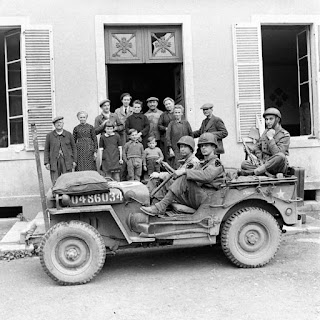
Pictures taken during the Battle for Hill 192 in Normandy - June/July 1944

Image
Pictures taken during the Battle for Hill 192 in Normandy - June/July 1944 Note that some of these pictures were taken in or near Saint-Georges-d'Elle Hill 192 was located between the cities of Saint-Lô and Bayeux in Normandy. The Battle was fought between elements of the 2nd US Infantry Division and the 16,000 strong 3rd German Fallschirmjäger (Parachute) Division, commanded by Generalleutnant Richard Schimf. Hill 192 gave the defending German forces good observation for miles in every direction. It needed to be taken in order for US General Omar Bradley to drive behind the German left flank and break out of Normandy; the attack that would become Operation Cobra. The terrain around Hill 192 also provided the German defenders excellent cover & concealment. US Lt. General Joseph Lawton Collins, found it worse country to fight in than Guadalcanal. The long battle among the Hedgerows finally culminated on July 10 when US forces captured Hill 192 and the surrounding area LIFE Magaz...

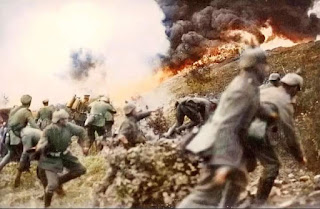
German soldiers launching an attack on 'Dead Man's Hill' during the Battle of Verdun, March 15-16, 1916. (Likely staged)

Image
German soldiers launching an attack on 'Dead Man's Hill' during the Battle of Verdun, March 15-16, 1916. (Likely staged) The following is excerpts of Danish-German Unteroffizier Friedrich Karl Dambeck's account of an attack on the Côte 304 at Verdun on June 29, 1916 - today 107 years ago. Translated by myself:  ⠀⠀⠀⠀⠀⠀⠀⠀⠀⠀⠀⠀ "Following the long and thorough preparation, on June 29 we were again to attempt taking the corpse-covered hill with a storm. Already on June 27 did Hauptmann Borchmann step forward to organise his storm units. Four units of 12 men each were necessary. The majority of these volunteered, the rest were drafted among the most experienced. Everyone stood in their right place at the established timestamp. At 5:15 the last heavy German shells exploded on the enemy's position, and worse than ever before it rained with splinters and rocks by our ears, all due to our heavy artillery. Suddenly the shells were subdued; the artillery fire had moved fur...

Fourth Battle of the Sonzo

Image
Fourth Battle of the Sonzo On November 10, 1915, the Fourth Battle of the Isonzo began. Like the Third Battle of Isonzo, which had ended just a week earlier, the main target of this Italian offensive was the city of Gorizia, as well as the heights of the Plateau de Carso. Since the last battle, the Italian strength had increased from 19 to 28 Divisions and the Austro-Hungarians from 11 to 15 Divisions. The Italians had 1,374 artillery cannons compared to only 626 Austro-Hungarian cannons. On November 10, 1915, the Italians launched the offensive against the Austro-Hungarians along the entire Isonzo Front, under heavy rains and under continuous Austrian artillery. The Italians suffered great losses and gained little gains, but they also inflicted great losses on Austro-Hungarians when they retaliated. On November 13, after intense artillery shelling and a bloody bayonet load, the Italians managed to capture some key trenching positions. On November 18, the Italians began bombing Gorizia...

Evidence of early human presence in the Arctic found on an ancient Woolly Mammoth :

Image
Evidence of early human presence in the Arctic found on an ancient Woolly Mammoth :  Paleolithic records of humans in the Eurasian Arctic (above 66°N) are scarce, stretching back to 30,000 to 35,000 years ago at most.  Pitulko et al. have found evidence of human occupation 45,000 years ago at 72°N, well within the Siberian Arctic.  The evidence is in the form of a frozen mammoth carcass bearing many signs of weapon-inflicted injuries, both pre- and postmortem.  The remains of a hunted wolf from a widely separate location of similar age indicate that humans may have spread widely across northern Siberia at least 10 millennia earlier than previously thought.